


Views: 0 Author: Site Editor Publish Time: 2026-10-14 Origin: Site


Coating failure hits the bottom line hard. When breading blows off fish fillets or shrimp in the fryer, you lose yield instantly. You also ruin your fryer oil. Loose crumb burns up, spikes oxidation rates, and forces you to filter or swap oil way more often than planned. Seafood is notoriously tough to coat. Fish and shellfish hold a lot of water. They also have irregular shapes—think of the deep cavities in calamari or butterflied shrimp. Getting batter and crumb to stick requires more than just dumping product on a belt. You need tight control over batter temps, surface moisture, and mechanical pressure. Fixing bald spots and blow-off means dialing in your dry-wet-dry process and running a seafood breading machine built specifically for your product's shape and your crumb type.
Moisture Management is Foundational: Effective adhesion requires strict control over surface moisture, typically achieved through optimized pre-dusting, advanced surface treatments, and the dry-wet-dry application method.
Machine Geometry Dictates Uniformity: Selecting between inline/flatbed and drum breaders must be dictated by the seafood’s shape (e.g., flat fillets vs. cavity-heavy products like calamari).
Mechanical Embedment Prevents Blow-Off: Industrial breaders must utilize adjustable pressure rollers and precise air blowers to embed the crumb and remove unattached excess before frying.
Sanitation Impacts Yield: Continuous crumb circulation and hygienic machine design prevent clumping and cross-contamination, directly influencing long-term operational ROI.
Table of Contents

Seafood muscle holds a massive amount of water. When you thaw or process fish, that moisture pushes to the surface. This creates a slick barrier. If you apply batter directly to wet protein, the batter cannot bind to the muscle fibers. It just floats on top of that microscopic water layer.
To fix this, plant managers use surface treatments. A quick edible alginate dip works well. It forms a thin gel that locks the internal moisture inside the muscle. This gives you a stable, dry surface for the pre-dust to grab.
If you ignore surface moisture, you get steam pockets in the fryer. The wet fish hits the 350°F oil. That surface water flashes into steam instantly. The steam expands, pushes against the setting batter, and blows the breading right off the fish. You end up with bald spots and ruined product.
Seafood Type | Moisture Challenge | Surface Topography | Recommended Prep |
|---|---|---|---|
Whitefish Fillets (Cod, Pollock) | High drip loss during thawing | Relatively flat, slight flaking | Alginate dip, heavy pre-dusting |
Whole Shrimp (Peeled) | Moisture trapped in tail joints | Curved, tight crevices | Air blow-off before battering |
Calamari Rings | Slick, rubbery protein surface | Tubular, internal cavities | Aggressive tumbling in pre-dust |
Scallops | Extremely high water retention | Cylindrical, smooth | Extended drain time, double pre-dust |
Batter is the glue that holds your crumb. Its sticking power depends entirely on viscosity, and viscosity depends on temperature. When the batter gets warm, it thins out. When it gets cold, it thickens up.
Processing floors are hot. Heat from fryers and motors transfers right into your batter tanks. As the batter warms up, it loses its grip. It runs right off the fish before the product even reaches the crumb bed. Without enough wet batter on the fish, the dry crumb has nothing to stick to. You get patchy coverage. You have to keep that batter chilled to a tight spec, usually around 40°F to 50°F, depending on your starch blend.
Fryers are violent environments. Oil boiling at high temps creates massive turbulence. We call the result blow-off. If your crumb isn't locked into the batter, the rolling oil simply washes it away.
Blow-off kills your line efficiency. All that loose crumb sinks to the fryer heating elements and turns to carbon. Carbonized crumb breaks down your oil chemistry fast. Free fatty acids spike. The oil gets dark, starts smoking, and tastes bitter. You end up stopping the line to filter the oil or dump it completely. Plus, those burnt specks float around and stick to the next batch of fish, causing QA rejections.
You cannot skip the pre-dust. The dry-wet-dry method is mandatory for seafood. The pre-dust layer does two jobs. First, it soaks up any surface water you missed during prep. Second, it gives the wet batter a rough surface to grab onto.
Setting up a proper pre-dust station requires a few specific steps:
Run the raw seafood under an air knife to blow off standing water.
Drop the product into a deep bed of fine flour or cracker meal.
Tumble or flip the product so the dust packs into every cut and crevice.
Pass the dusted product under a high-velocity blower to strip away loose, unattached powder.
If you skip step four, that loose dust falls into your batter tank. It forms dough balls, clogs your pumps, and ruins your viscosity.
Your batter mix usually contains wheat flour, modified corn starches, and leavening agents. The starches act as the adhesive. The leavening agents create the bubbles that make the coating crispy instead of hard.
You cannot mix batter by hand in a bucket and expect consistent results. You need an automated mixing system tied to a chiller. The system constantly measures the thickness of the liquid. If the batter thins out, the machine automatically doses in more dry mix. If it gets too thick, it adds chilled water. This keeps your pickup percentage dead even from the start of the shift to the final washdown.
Do not drop freshly breaded fish straight into the fryer. You need a resting phase on the belt. We call this dwell time.
During dwell time, the moisture from the wet batter moves outward into the dry crumb. The starches in the crumb absorb that water and swell up. This locks the layers together. If you rush the product into the oil before the starches hydrate, the thermal shock will blow the dry crumb right off. Give the product 30 to 60 seconds of belt travel time before it hits the oil.
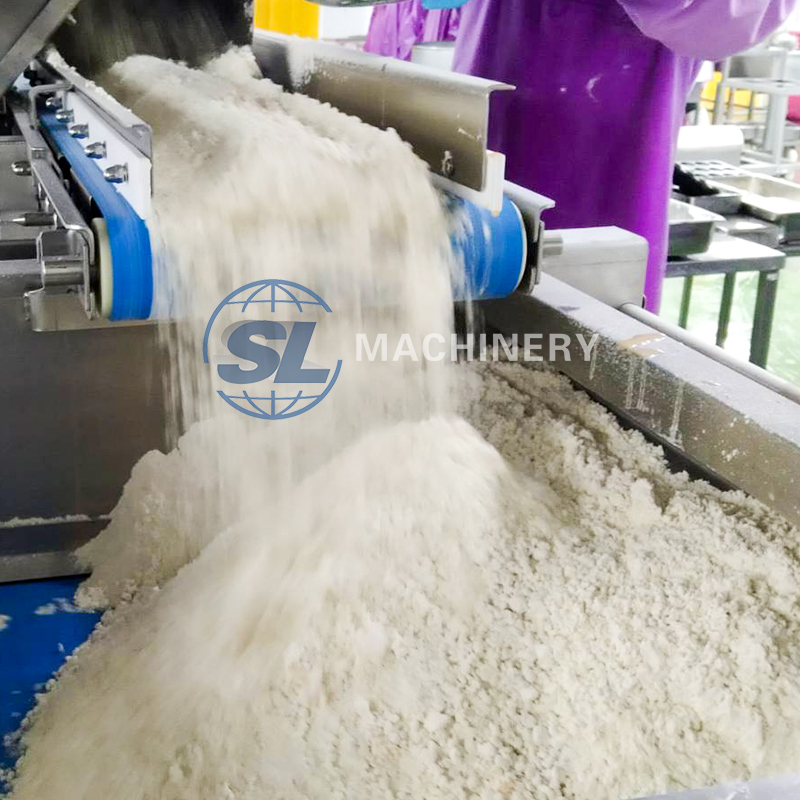
Flatbed seafood breading machines use conveyor belts and upper and lower crumb layers to coat delicate products without tumbling. They are suitable for fish fillets, fish sticks, and formed seafood patties. This gentle process helps maintain product shape, although irregular surfaces may require additional coating adjustments. Explore Shanlin's seafood processing machinery for related equipment.
Drum breading machines use rotating or tumbling mechanisms to coat irregularly shaped seafood, including popcorn shrimp, calamari, and clam strips. Continuous product movement helps distribute breadcrumbs into uneven surfaces and improves coating coverage. However, delicate fish fillets may require gentler processing methods to prevent damage.
Panko breading machines are designed to handle lightweight, fragile Japanese breadcrumbs without excessive crushing. Gentle conveyors and suitable crumb circulation systems help preserve Panko texture and maintain consistent coating quality. These machines are ideal for Japanese-style breaded shrimp, fish fillets, and premium crispy seafood products.
Machine Type | Best Applications | Main Advantage |
|---|---|---|
Flatbed / Inline Breader | Fish fillets, fish sticks, patties | Gentle product handling |
Drum Breader | Popcorn shrimp, calamari, irregular seafood | Better coverage of uneven surfaces |
Panko Breader | Tempura-style shrimp, Panko fish fillets | Preserves delicate breadcrumb texture |
Consistent seafood breading quality depends on adjustable pressure rollers, excess crumb removal, and synchronized conveyor speeds. These components help improve coating adhesion, reduce material waste, and maintain uniform finished product appearance.
Breading machine pressure rollers help press breadcrumbs into the batter layer for stronger adhesion. Adjustable roller height and pressure accommodate different seafood thicknesses while preventing excessive compression. Proper settings improve coating consistency and reduce product damage.
Air blowers and air knives remove loose breadcrumbs before seafood enters the fryer. Adjustable airflow helps reduce crumb waste, prevent excessive oil contamination, and improve finished coating quality. Air pressure should be carefully controlled to avoid removing properly attached breading.
Variable-speed conveyor systems synchronize breading machines with upstream battering equipment and downstream fryers. Efficient crumb circulation and screening remove unwanted batter lumps while preserving reusable breadcrumbs. These features support stable production speeds and reduce coating defects.
Proper seafood breading machine installation requires compatible conveyor dimensions, sufficient workspace, and integration with existing battering and frying equipment. Matching equipment capacities and transfer heights helps prevent product damage, reduce bottlenecks, and maintain continuous processing.
Seafood breading production lines require suitable equipment spacing, conveyor alignment, and consistent belt widths. Smooth product transfers help prevent uneven coating and seafood deformation. Modular or mobile breading equipment can also improve flexibility when switching between breaded and unbreaded products.
Hygienic seafood breading machines should feature food-grade stainless steel, accessible cleaning surfaces, and removable components. Appropriate washdown protection and efficient drainage help maintain sanitary production conditions. Buyers should verify equipment suitability for applicable food safety requirements and cleaning procedures.
Seafood breading machine maintenance includes regular inspection of conveyor belts, bearings, crumb circulation systems, and pneumatic components. Operator training should cover belt speed adjustment, coating settings, cleaning, and troubleshooting. Clear operating procedures help reduce downtime and maintain consistent product quality.
Preventing coating loss requires the precise alignment of moisture management, batter rheology, and the correct mechanical application of the crumb. Follow these actionable steps to lock down your process:
Audit your current line to identify exactly where coating loss occurs, checking surface moisture levels before the batter stage.
Match your equipment to your product by selecting flatbed systems for delicate fillets and drum systems for irregular shapes like calamari.
Install automated viscosity controllers on your batter tanks to eliminate temperature-driven fluctuations during long shifts.
Schedule a live factory acceptance test using your specific seafood and crumb type to prove the machine's pickup rates before installation.
A: Breading falls off due to moisture migration and thermal shock. As frozen fish thaws, surface water creates a slick barrier that prevents batter from sticking. When this wet layer hits hot fryer oil, the water instantly turns to steam. The expanding steam physically blows the coating off the muscle protein.
A: It depends on the product style. For popcorn or whole round shrimp, drum breaders work best because their tumbling action packs crumb into tight cavities. For delicate, butterflied shrimp, use an inline flatbed machine to maintain the shape and prevent the meat from tearing.
A: You control viscosity using automated mixing tanks tied to chilling units. These systems use inline sensors to constantly measure the batter's thickness. If ambient plant heat thins the batter, the system automatically doses in dry mix or drops the jacket temperature to keep the viscosity locked at your target spec.
A: Bald spots happen when products overlap on the belt, blocking the crumb curtain. They also occur if your batter is too thin to hold the crumb, or if you skip the pre-dust step. Without pre-dust, the wet batter slides right off the slick fish, leaving bare patches.
A: Greasy seafood usually comes from crushed crumb dust. If your equipment grinds the breading into a fine powder, that dust acts like a sponge in the fryer. Failing to use air blowers to strip away loose crumb before the fryer also causes massive oil absorption.
A: Standard machines ruin Panko. Heavy-duty augers designed for flour will crush fragile Panko flakes into dust. To run both, you need a specialized machine with gentle-handling features like vibratory conveyors and wide-pitch belts that move delicate crumbs without grinding them up.
A: Pre-dusting acts as the primary anchor layer. The dry powder absorbs any leftover surface water on the raw fish. It creates a rough, high-friction texture. This gives the wet batter something physical to grip, locking the entire coating system to the seafood substrate.


