


Views: 0 Author: Site Editor Publish Time: 2026-10-14 Origin: Site


The global demand for premium, uniform tempura shrimp requires strict standardization of Nobashi Ebi, which refers to stretched, peeled, tail-on shrimp. Maintaining this standard at scale through manual labor proves nearly impossible for modern processing facilities. Manual shrimp stretching introduces severe production bottlenecks, high labor overhead, inconsistent product lengths, and a higher risk of meat damage or cross-contamination. Transitioning to an automated shrimp nobashi machine resolves these throughput limitations directly. Selecting the right equipment requires a rigorous evaluation of stretching mechanisms, size adaptability, automation levels, facility space, and integration capabilities with existing seafood processing lines.
Throughput vs. Yield: High-capacity machines must balance pieces-per-minute (PPM) with gentle stretching mechanisms to prevent tail breakage and preserve the firm texture required for premium tempura.
Size & Species Adaptability: The most viable machines offer rapid calibration to accommodate fluctuating shrimp grades, weights, and species characteristics without prolonged downtime.
Automation Level & Footprint: Selecting between semi-automatic and fully automatic processing lines depends heavily on available facility space, budget constraints, and daily volume targets.
Sanitation Standards: Equipment must feature hygienic design (e.g., IP69K washdown ratings, 304/316 stainless steel) to mitigate bacterial risks inherent in raw seafood processing.
Operational ROI: True ROI is calculated not just on labor reduction, but on the availability of spare parts, maintenance frequency, and minimized yield loss.
Table of Contents

Automated Nobashi shrimp stretching improves production consistency by replacing manual cutting and pressing with controlled mechanical processing. It helps reduce labor dependency, uneven stretching, and shrimp damage while maintaining more stable production output. Explore Shanlin's Shrimp Nobashi Machines for commercial seafood processing applications.
Nobashi shrimp machine performance should be evaluated based on processing capacity, tail breakage rates, stretching consistency, and finished product quality. Buyers should establish measurable targets for pieces per minute, acceptable defects, and shrimp length extension. Actual results depend on shrimp size, species, machine settings, and processing conditions.
Automatic shrimp stretching machines reduce repetitive manual operations and provide more consistent processing speeds. Compared with manual stretching, automated systems can improve productivity, reduce operator-related variations, and support smoother integration with peeling, coating, and packaging lines.
Production Factor |
Manual Stretching |
Automated Stretching |
|---|---|---|
Processing Speed |
Depends on operator efficiency |
More consistent machine-controlled output |
Labor Requirements |
Higher |
Lower |
Stretching Consistency |
Greater variation |
More uniform |
Tail Damage |
Depends on operator technique |
Controlled through machine calibration |
Production Planning |
Less predictable |
Easier to coordinate |
Nobashi shrimp stretching machines use controlled rollers or pressing mechanisms to extend shrimp while minimizing damage to the flesh and tail. Proper pressure adjustment helps reduce curling during frying and maintain a consistent appearance. Accurate shrimp grading and machine calibration are essential for preserving product texture and quality.
Selecting a suitable shrimp stretching machine requires evaluating processing speed, shrimp size compatibility, adjustment flexibility, and product quality. Equipment should match actual production volumes and accommodate different shrimp specifications without excessive changeover time.
Shrimp Nobashi machine capacity should match daily production requirements and available labor. Semi-automatic systems involve manual feeding with mechanical stretching, while more automated configurations can reduce handling between processing stages. Buyers should balance throughput, equipment footprint, and finished product quality when comparing machine options.
Shrimp size grading and machine calibration directly affect stretching accuracy. Different shrimp sizes and species, including Vannamei and Black Tiger shrimp, may require adjustments to roller spacing and pressure. Machines with flexible settings and efficient changeovers help processors maintain consistent results across different batches.
The physical method used to elongate the shrimp determines your final product quality. The industry primarily relies on two distinct technologies: roller-based stretching and press-based stretching. You must analyze how the machine grips the tail-on section. The telson and uropods (the tail components) are highly fragile. If the mechanism applies lateral force incorrectly, the tail snaps off. This downgrades the product immediately.
Feature |
Roller-Based Technology |
Press-Based Technology |
|---|---|---|
Mechanism Action |
Uses sequential pairs of rotating cylinders to pull and elongate the shrimp continuously. |
Uses descending plates to apply static downward pressure, flattening and extending the muscles. |
Throughput Speed |
Exceptionally high. Supports continuous, high-speed inline processing. |
Moderate. Operates on a cyclical, indexing basis rather than continuous flow. |
Yield Preservation |
Requires precise gap calibration to avoid tearing the flesh during the pulling action. |
Excellent for maintaining meat integrity, though risks over-flattening if pressure is too high. |
Best Application |
High-volume export facilities processing uniform sizes of Vannamei shrimp. |
Facilities processing varying species or thicker Black Tiger shrimp requiring controlled force. |
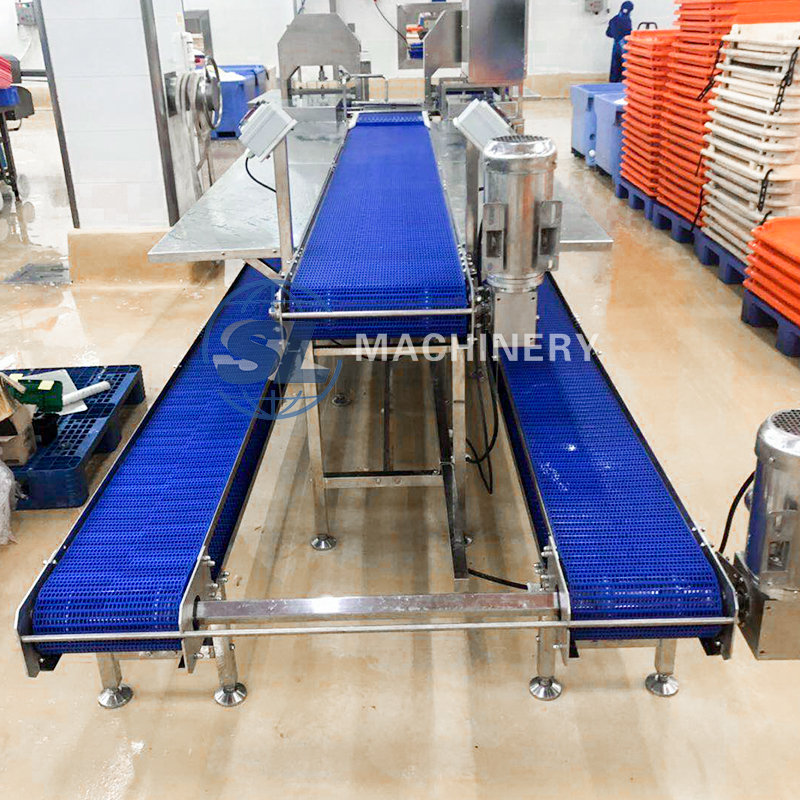
Shrimp Nobashi machines should integrate smoothly with upstream peeling and deveining equipment and downstream coating, frying, and packaging systems. Proper conveyor alignment and synchronized production speeds reduce manual handling, prevent bottlenecks, and improve processing efficiency. Learn more about Shanlin's complete shrimp processing workflow.
Shrimp peeling and deveining are essential preparation steps before Nobashi stretching. Properly processed peeled, tail-on (PTO) shrimp help minimize tail damage and ensure consistent stretching results. Integrating a shrimp peeling machine with compatible conveying equipment can streamline production and reduce manual handling.
Stretched Nobashi shrimp require consistent length and positioning for downstream coating, frying, and packaging. Proper alignment helps achieve uniform batter coverage and accurate tray placement. Integrating stretching equipment with breading, frying, and packaging machines supports smoother production and consistent finished product quality.
Food safety in shrimp processing depends on hygienic equipment design, appropriate cleaning procedures, and effective contamination control. Shrimp stretching machines should use food-contact-safe materials, accessible components, and suitable moisture protection to support sanitation in demanding seafood production environments.
Stainless steel shrimp processing equipment offers corrosion resistance and supports hygienic operation. Food-contact components commonly use 304 or 316 stainless steel, depending on environmental and cleaning requirements. Electrical enclosures and sensors should have suitable ingress protection ratings based on the intended washdown conditions.
Hygienic shrimp stretching machine design should provide accessible conveyors, removable components, and easy-to-clean surfaces. Quick-release mechanisms and open-frame construction can simplify cleaning and reduce residue buildup. Regular sanitation and maintenance help protect food quality and minimize production downtime.
Investing in an automatic shrimp Nobashi machine can reduce manual stretching requirements, improve product uniformity, and increase processing efficiency. Manufacturers should evaluate equipment costs, labor savings, product yield, and maintenance expenses to determine long-term return on investment.
Shrimp Nobashi machine ROI depends on equipment investment, labor reduction, processing capacity, and finished product yield. Automated stretching can reduce repetitive manual operations while improving shrimp size consistency. Comparing total operating costs with expected production output helps manufacturers estimate potential cost savings.
Preventive maintenance helps maintain reliable shrimp stretching performance. Regular inspection of stretching belts, rollers, and guide components can reduce unexpected breakdowns. Buyers should also evaluate spare parts availability, warranty coverage, and supplier technical support to minimize production interruptions.
Shrimp stretching machine installation requires careful calibration, consistent raw material preparation, and operator training. Incorrect settings or inconsistent shrimp sizes can lead to damaged tails, uneven stretching, and lower product yield. Standardized operating procedures help maintain stable performance.
Shrimp tail breakage often results from incorrect roller pressure, inconsistent shrimp grading, or excessive stretching. Operators should adjust machine settings according to shrimp size and conduct small test batches before full production. Regular inspection of tail integrity, shrimp length, and appearance helps reduce defects and improve product consistency.
Shrimp Nobashi machine operator training should cover shrimp feeding, roller adjustment, cleaning, troubleshooting, and routine maintenance. Clear Standard Operating Procedures (SOPs) help employees identify processing problems and maintain consistent output. Supplier-supported commissioning and technical training can simplify equipment adoption.
Implementing automated stretching technology transforms commercial seafood processing operations. It eliminates the inconsistencies of manual labor, standardizes product quality, and ensures the precise physical dimensions required for premium tempura production. Success depends entirely on selecting equipment that matches your specific processing environment and raw material characteristics.
Audit your current manual throughput and document your baseline defect rates to establish clear performance targets.
Measure the available floor space in your facility to determine if a semi-automatic or fully automatic inline system fits your layout.
Identify the primary shrimp species and size grades you process daily to ensure the machine offers the necessary calibration flexibility.
Request physical equipment demonstrations or pilot yield tests using your facility's specific raw shrimp supply to validate stretching consistency.
A: Commercial machines typically process between 200 and 400 pieces per minute. The exact capacity depends on the machine's automation level, the size of the shrimp, and the efficiency of the operators feeding the infeed guides in semi-automatic setups.
A: Yes. High-quality machines feature adjustable roller gaps and pressure settings. Operators can calibrate the equipment to handle different counts and adapt to the varying shell hardness of species like Vannamei and Black Tiger.
A: A semi-automatic machine requires human operators to manually place peeled shrimp into the machine's infeed slots. A fully automatic machine integrates directly with upstream peeling equipment, receiving and stretching the shrimp via continuous conveyors without human intervention.
A: Automated stretching applies precise, uniform pressure to break the ventral muscles without crushing the meat. This preserves the firm, snappy texture and sweet taste of the shrimp much better than inconsistent manual scoring and pressing.
A: The stretching machine requires Peeled, Tail-On (PTO) shrimp. You need automated peeling machines capable of removing the shell and head while leaving the tail segment completely intact and undamaged.
A: Equipment must be constructed from 304 or 316 stainless steel and feature IP69K-rated electrical components. Daily sanitation requires high-pressure, high-temperature washdowns and the tool-less disassembly of belts and rollers to clean all harborage points.
A: Prevent tail breakage by enforcing strict upstream size grading. Ensure the machine is precisely calibrated for the specific weight and species being processed. Floor supervisors must perform test runs after every size changeover to verify settings.


