


Views: 0 Author: Site Editor Publish Time: 2026-10-14 Origin: Site


Vannamei, or whiteleg shrimp, dominates the global aquaculture market. Processing facilities face massive pressure to scale production while fighting chronic labor shortages and rising operational costs. Manual processing creates a severe bottleneck on the factory floor. Relying on human hands introduces inconsistent product quality, high contamination risks, and unacceptable yield loss. In high-volume operations, even a 1% drop in yield destroys profit margins.
Upgrading to automated industrial processing lines solves this problem directly. Transitioning away from manual labor stabilizes throughput and standardizes the final product. We will evaluate the technical criteria for selecting peeling, deveining, and breading machinery. By understanding the mechanics of these systems, you can optimize throughput, preserve meat integrity, and ensure strict regulatory compliance across your entire production floor.
Yield is the Ultimate Metric: The primary ROI driver for upgrading shrimp processing equipment is the measurable reduction in meat damage and waste during the peeling and deveining stages.
Pre-Processing Dictates Downstream Success: Accurate mechanical grading and heading are prerequisites for maximizing the efficiency of automated peeling machines.
Modularity Drives Scalability: Modern processing lines must allow for modular integration, enabling facilities to switch between presentations (e.g., completely peeled, tail-on, butterfly) without full-line replacement.
Coating Precision Determines Final Value: Automated breading lines require strict viscosity and temperature controls to ensure uniform coating adhesion on delicate Vannamei profiles.
Sanitary Design is Non-Negotiable: Equipment must feature open-channel designs, IP69K-rated components, and Clean-in-Place (CIP) capabilities to meet strict HACCP and FDA compliance standards.
Table of Contents

Automated Vannamei shrimp processing helps seafood manufacturers reduce labor dependency, improve production consistency, and increase processing efficiency. Compared with manual operations, automated systems provide more predictable output, reduce repetitive handling, and support large-scale production. Explore Shanlin's shrimp processing equipment for different production requirements.
Automatic shrimp processing machines reduce manual peeling, deveining, and handling requirements while maintaining more consistent production speeds. This helps manufacturers manage labor costs, improve productivity, and meet growing order demands.
Shrimp processing yield depends on accurate peeling, controlled handling, and consistent machine settings. Automated equipment can reduce meat damage, improve finished product uniformity, and minimize material waste.
Automated shrimp processing lines provide more predictable throughput and support coordinated production scheduling. Manufacturers can evaluate capacity, equipment uptime, water consumption, and product yield to optimize operations and plan future expansion.
Hygienic shrimp processing automation reduces unnecessary manual contact and supports more consistent handling procedures. Combined with proper sanitation and quality control, automated equipment can help reduce contamination risks and maintain reliable product quality.
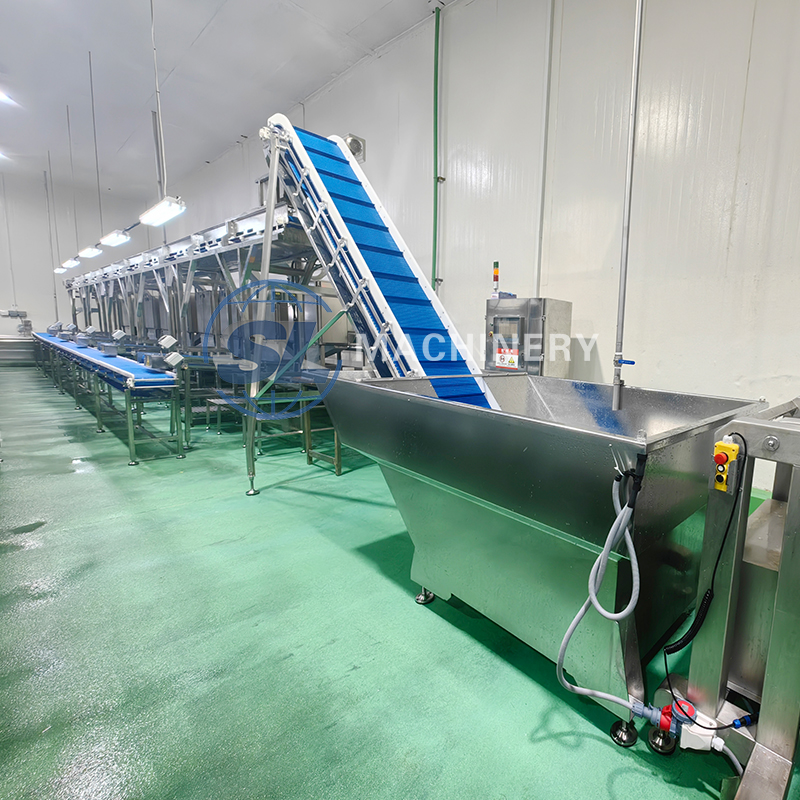
Vannamei shrimp processing machines cover multiple production stages, including heading, grading, peeling, deveining, coating, and quality inspection. Selecting compatible equipment helps seafood processors improve production efficiency, reduce manual handling, and maintain consistent product quality.
Shrimp heading and grading machines prepare raw Vannamei shrimp for downstream processing. Heading equipment removes shrimp heads while minimizing meat loss, while grading systems separate shrimp by size to improve peeling consistency. Accurate sorting helps reduce equipment adjustments, product damage, and processing waste.
Automatic shrimp peeling machines remove shells while maintaining shrimp meat integrity. Depending on machine design, adjustable mechanical components support different shrimp sizes and processing styles, including peeled and deveined (P&D), tail-on (PTO), and peeled and undeveined (PUD). Proper calibration improves yield and reduces manual labor.
Explore Shanlin's automatic shrimp peeling machine, which supports multiple shrimp sizes and processing configurations.
Processing Style | Main Characteristics | Common Applications |
|---|---|---|
PUD (Peeled and Undeveined) | Shell removed, vein retained | Bulk food processing |
P&D (Peeled and Deveined) | Shell and vein removed | Frozen shrimp and retail products |
PTO (Peeled Tail-On) | Shell removed, tail retained | Tempura, breaded shrimp, and shrimp rings |
Butterfly Shrimp | Back-cut and opened presentation | Coated and fried shrimp products |
Shrimp deveining machines remove the digestive tract through controlled cutting and cleaning mechanisms. Accurate blade positioning and suitable water delivery help minimize meat damage while maintaining product appearance. Equipment should accommodate different shrimp sizes and support consistent processing quality.
For combined processing, Shanlin's shrimp peeling and deveining equipment supports several finished shrimp presentations.
Shrimp coating equipment applies flour, batter, and breadcrumbs to achieve consistent coverage and texture. Adjustable conveyor speeds and suitable coating mechanisms help accommodate products such as Panko shrimp, tempura shrimp, and breaded seafood. Gentle material handling reduces coating damage and product waste.
Explore Shanlin's flour coating and breadcrumb coating machines for related processing applications.
Shrimp quality inspection systems help detect processing defects, residual shells, foreign materials, and inconsistent product appearance. Depending on the production line, vision inspection, metal detection, or X-ray systems may be integrated before packaging. Suitable inspection methods support product quality and food safety requirements.
Choosing suitable Vannamei shrimp processing equipment requires evaluating production capacity, material yield, hygienic construction, and utility consumption. Equipment should match factory conditions and support reliable operation across different shrimp sizes and processing requirements.
Shrimp processing machine capacity should match daily production targets and available factory space. High-volume lines require sufficient room for conveyors, processing stations, and maintenance access. Compact configurations may suit smaller facilities, while continuous production lines support larger processing volumes.
Shrimp processing yield depends on accurate peeling, deveining, and product handling. Efficient equipment helps minimize meat loss and separates shells, heads, and other waste from finished shrimp. Proper waste collection improves sanitation and may support byproduct recovery.
Hygienic shrimp processing equipment should use food-contact-safe materials, corrosion-resistant construction, and accessible cleaning surfaces. Stainless steel components, removable conveyors, and suitable drainage help reduce contamination risks. Buyers should verify cleaning requirements and applicable food safety standards.
Energy-efficient seafood processing equipment helps reduce electricity, water, and operating expenses. Efficient motors, controlled water delivery, and suitable wastewater management systems can improve resource utilization. Manufacturers should compare actual utility requirements when evaluating machine configurations.
Integrated shrimp processing lines combine preparation, peeling, deveining, coating, cooking, and packaging equipment into a coordinated workflow. Proper machine compatibility reduces unnecessary handling and production bottlenecks.
Explore Shanlin's seafood processing solutions for a complete overview of shrimp processing stages.
Evaluation Factor | Standalone Machines | Integrated Processing Lines |
|---|---|---|
Initial Investment | Generally lower | Generally higher |
Installation | Easier for targeted upgrades | Requires coordinated planning |
Production Flow | May involve manual transfers | More continuous processing |
Labor Requirements | Depends on individual equipment | Potentially lower with automation |
Expansion Flexibility | Add machines as needed | Depends on modular design |
Best Application | Small facilities or specific bottlenecks | Medium-to-large seafood processors |
Shrimp processing machine ROI depends on equipment investment, labor savings, usable product yield, utilities, and maintenance costs. Higher automation may improve throughput and reduce manual handling, but buyers should evaluate actual operating conditions and expected production volumes before investing.
Automated shrimp processing systems may incorporate adjustable controls, production monitoring, and fault detection to improve operational consistency. Advanced connectivity and monitoring features depend on the selected equipment configuration. Buyers should confirm integration capabilities and after-sales support with the supplier.
Audit your current production lines to identify the primary bottleneck (e.g., is labor cost highest in peeling, or is quality suffering in breading?) and prioritize equipment upgrades accordingly.
Define your exact throughput requirements, compile historical yield data, and request live equipment demonstrations or pilot runs using your own raw Vannamei product.
Develop a comprehensive preventative maintenance schedule and spare parts inventory plan prior to installation.
Establish a dedicated operator training program focused on HMI navigation, VFD calibration, and safe jam-clearing procedures.
A: The ROI timeline typically ranges from 12 to 24 months. This depends heavily on your local labor rates, the volume of shrimp processed daily, and the specific yield improvements achieved. High-volume facilities operating multiple shifts often see faster returns due to the drastic reduction in manual labor costs and improved meat retention.
A: Automated deveining significantly improves yield consistency. Manual deveining often results in deep, jagged cuts that remove excess meat and ruin the shrimp's structure. Automated machines use precision depth sensors and optical guides to make shallow, exact cuts, preserving maximum weight and maintaining an appealing butterfly presentation.
A: Yes, many modern peeling machines feature modular designs. Operators can adjust settings, engage specific pinch rollers, or swap out cutting mechanisms to switch between tail-on (PTO) and completely peeled (PUD/P&D) presentations. This flexibility allows facilities to adapt to changing market demands without buying separate processing lines.
A: Peeling machines calibrate their roller pressure and blade depth based on shrimp size. If ungraded shrimp enter the machine, the settings will crush larger shrimp, causing severe yield loss, while smaller shrimp will pass through unpeeled. Accurate grading ensures uniform processing and protects meat integrity.
A: Water consumption varies widely by machine type and capacity. Traditional systems can use thousands of liters per hour for fluming and lubrication. However, modern equipment often integrates closed-loop water recycling systems that filter and reuse flume water, drastically reducing overall municipal water intake and wastewater discharge.
A: Automated lines use specialized diaphragm pumps and temperature-controlled reservoirs. Diaphragm pumps move the batter without creating high shear stress, which prevents the starches from breaking down. Chilled jackets on the tanks keep the batter at an optimal temperature, ensuring consistent viscosity and uniform crumb adhesion.
A: Yes, advanced X-ray systems are highly effective at detecting calcified shell fragments, even when the shrimp is covered in thick batter and breading. They analyze density variations to spot shells, cartilage, and foreign materials, triggering high-speed pneumatic rejectors to remove the defective product from the line instantly.


