


Views: 0 Author: Site Editor Publish Time: 2026-09-11 Origin: Site


Choosing the right shrimp processing machine starts with one simple question: what product do you want to make?
A factory producing peeled and deveined shrimp needs different equipment from a processor supplying straight shrimp for tempura. A company producing shrimp cakes or other formed seafood products has another set of requirements.
This guide compares the main types of shrimp processing machines and explains what to consider before making a purchase.
Table of Contents
Machine | Main Function | Suitable Products | Best For |
|---|---|---|---|
Removes shells and veins | Peeled shrimp, deveined shrimp, tail-on or tail-off shrimp | High-volume raw shrimp processing | |
Stretches and straightens shrimp | Nobashi shrimp, tempura shrimp | Processors supplying Japanese-style and premium shrimp products | |
Forms seafood mixtures into consistent shapes | Shrimp cakes, fish cakes, seafood patties | Value-added seafood production | |
Flour coating machine | Applies an even flour layer | Breaded shrimp and coated seafood | Pre-coating before battering or breading |
Breadcrumb coating machine | Covers products with breadcrumbs | Breaded shrimp, seafood patties | Ready-to-fry seafood products |
Continuous fryer | Fries products continuously | Fried shrimp and coated seafood | Continuous cooked-food production |

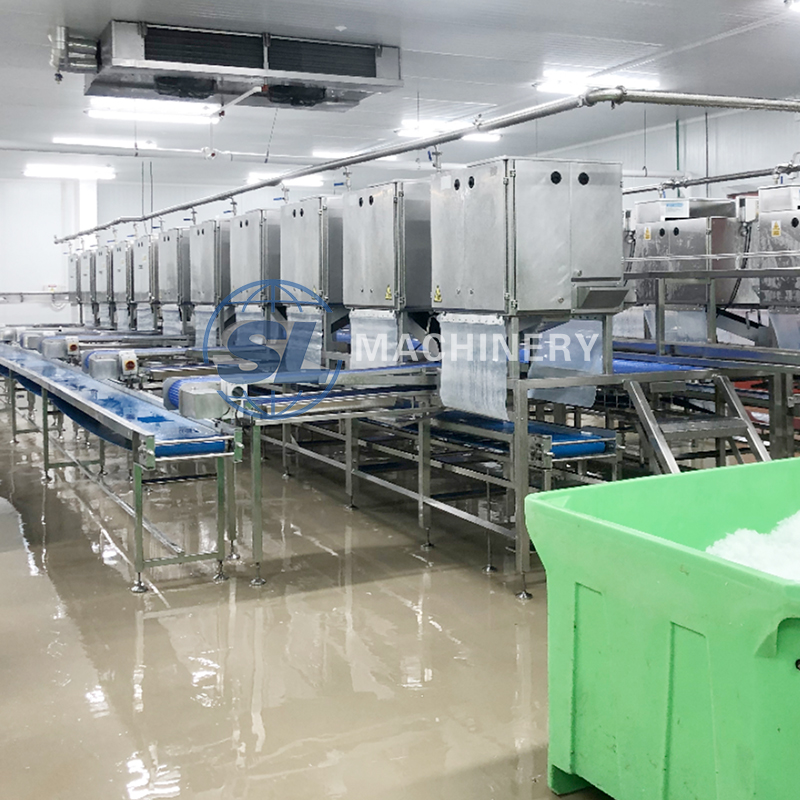
A shrimp peeling and deveining machine is designed for processors that need to remove shrimp shells and veins efficiently.
It is commonly used to produce:
Peeled and deveined shrimp
Tail-on peeled shrimp
Tail-off peeled shrimp
Butterfly-cut shrimp
Shrimp prepared for freezing or further processing
This machine is suitable for seafood factories handling large quantities of raw shrimp. Compared with manual processing, automated peeling helps improve production consistency and reduce dependence on a large peeling workforce.
Before choosing a machine, confirm the shrimp species and size range it can process. Shrimp shell thickness, body shape and size can affect the peeling result. A machine should therefore be tested with the shrimp used in your own factory.
Choose this machine if: your main products are peeled, deveined or butterfly shrimp.
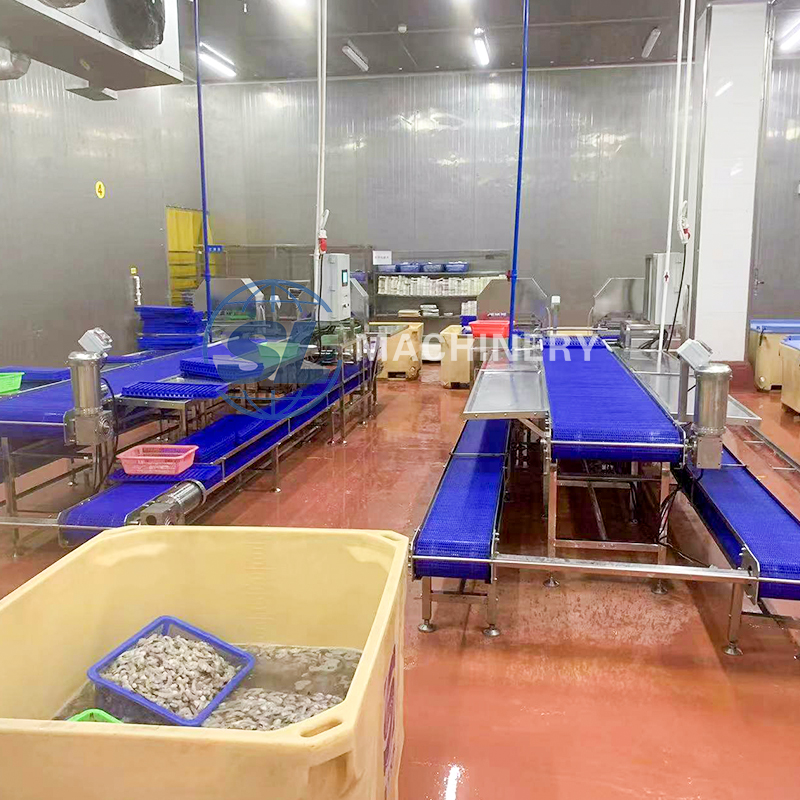
A shrimp Nobashi machine is used to stretch and straighten peeled shrimp. Nobashi shrimp are commonly supplied to tempura producers, Japanese restaurants and frozen-food manufacturers.
The machine helps processors create shrimp with a more consistent length and straight appearance. Uniform shrimp are easier to coat, arrange and package.
When comparing Nobashi machines, focus on:
Final shrimp length
Shape consistency
Adjustment for different shrimp sizes
Damage or breakage during stretching
Ease of operation and cleaning
The longest shrimp is not always the best result. The machine should stretch the shrimp evenly without seriously damaging its structure or appearance.
Choose this machine if: you produce straight shrimp for tempura or other premium prepared-food applications.

A shrimp and fish cake forming machine shapes prepared seafood mixtures into products of consistent size and weight.
It can be used for:
Shrimp cakes
Fish cakes
Seafood patties
Mixed shrimp and fish products
Other formed seafood products
This machine is especially useful for processors developing value-added products. Smaller pieces of shrimp, fish and other suitable ingredients can be mixed according to a product recipe and formed into a standard shape.
Important selection factors include mold options, product weight, mixture consistency and forming speed. The supplier should test the actual recipe because different mixtures may behave differently during forming.
Choose this machine if: you produce shrimp cakes, fish cakes, seafood patties or other formed products.
Peeling, stretching and forming machines prepare the seafood, but additional equipment may be required for coated or cooked products.
A flour coating machine applies the first dry layer to shrimp, seafood cakes or other products. A breadcrumb coating machine then applies a more visible outer coating. If the product needs to be cooked, a continuous fryer can be added after the coating process.
A typical breaded shrimp line may include:
Peeling and deveining → inspection → flour coating → battering → breadcrumb coating → frying or freezing
Not every processor needs a complete line. The correct configuration depends on whether the final product is sold raw, coated, pre-fried or fully cooked.
Do not choose equipment based only on its processing speed. First define exactly what you plan to sell.
For example:
Peeled frozen shrimp require peeling and deveining equipment.
Tempura shrimp require peeling followed by Nobashi stretching.
Shrimp cakes require mixing and forming equipment.
Breaded shrimp require peeling, coating and possibly frying equipment.
A clear product plan prevents you from buying unnecessary machines.
Shrimp are not uniform raw materials. Different species and size grades may have different shell hardness, body shapes and moisture levels.
Provide the supplier with information about:
Shrimp species
Shrimp count or size range
Fresh or thawed condition
Head-on or head-off condition
Required tail style
Desired finished product
Whenever possible, arrange a processing test using your own shrimp.
Machine capacity should match both upstream and downstream equipment. A fast peeling machine will not improve total output if inspection, coating, freezing or packing cannot keep up.
Calculate the required capacity based on:
Daily production target
Working hours per shift
Number of shifts
Seasonal peak volume
Capacity of downstream equipment
Choose a practical working capacity rather than relying only on the advertised maximum speed.
Processing speed matters, but finished-product quality is equally important. Poor peeling or excessive breakage can reduce the amount of saleable shrimp.
During a test, check:
Peeling completeness
Deveining accuracy
Broken shrimp percentage
Meat remaining on discarded shells
Finished shrimp appearance
Consistency between batches
The best machine is the one that provides stable output while protecting the value of the shrimp.
Seafood processing equipment must be cleaned frequently. Machines with complicated structures or difficult-to-reach areas can increase cleaning time.
Ask the supplier:
Which parts must be removed for cleaning?
Can the belts, trays or molds be removed easily?
How long does daily cleaning normally take?
Which parts require regular replacement?
Are operating and maintenance instructions provided?
How quickly can spare parts be supplied?
Simple cleaning and maintenance procedures help reduce production interruptions.
Before purchasing, confirm the machine dimensions and working area. Allow additional space for feeding, product discharge, operator access, cleaning and maintenance.
If the machine will become part of an existing shrimp processing line, provide the supplier with a floor plan. This helps determine whether additional conveyors or layout changes are required.
The following summary can help narrow down the choice:
Choose a shrimp peeling and deveining machine for peeled, deveined, tail-on, tail-off or butterfly shrimp.
Choose a shrimp Nobashi machine for straight shrimp used in tempura and Japanese-style foods.
Choose a shrimp/fish cake forming machine for shrimp cakes, fish cakes and other formed seafood products.
Add coating machines when producing breaded or battered shrimp.
Add a continuous fryer when producing pre-fried or fully fried products.
Some factories only need one machine. Others may require several machines connected into a complete shrimp processing line.
Before making a final decision, send the supplier a clear list of requirements:
What shrimp species and sizes can the machine process?
What finished products can it produce?
What is the recommended working capacity?
Can the machine be tested with our shrimp?
How many operators are required?
How is the machine cleaned?
Which spare parts should be kept in stock?
Can the machine connect with our existing equipment?
Is operator training available?
Can the machine configuration be adjusted for our product?
Clear information helps the supplier recommend a suitable model instead of simply offering the largest machine.
There is no single shrimp processing machine that is suitable for every factory. The correct choice depends on the raw shrimp, final product, required capacity, factory layout and processing steps.
Peeling and deveining machines are suitable for raw shrimp preparation. Nobashi machines are designed for straight tempura shrimp, while forming machines are used for shrimp cakes and other value-added seafood products. Coating and frying equipment can be added when producing breaded or cooked shrimp.
Shanlin Machinery provides seafood processing machinery for peeling, stretching, forming, coating and frying applications. Share your shrimp species, size range, desired product and production capacity with our team, and we can help you identify a suitable machine or processing-line configuration.
Usually not. Peeling, deveining, stretching, forming, coating and frying are different processes. A complete production line may require several machines.
Provide the shrimp species, size range, raw material condition, finished product, required capacity, available factory space and local power supply.
Not necessarily. The capacity should match your actual production target and the speed of the other equipment in the line. Excess capacity may increase the investment without improving total output.
Some machines can process multiple size ranges, but adjustments may be required. Confirm the supported range with the supplier and request a test using your own shrimp.
In many cases, yes. The supplier should review the existing workflow, machine dimensions, conveyor height and available space before recommending an integration plan.


